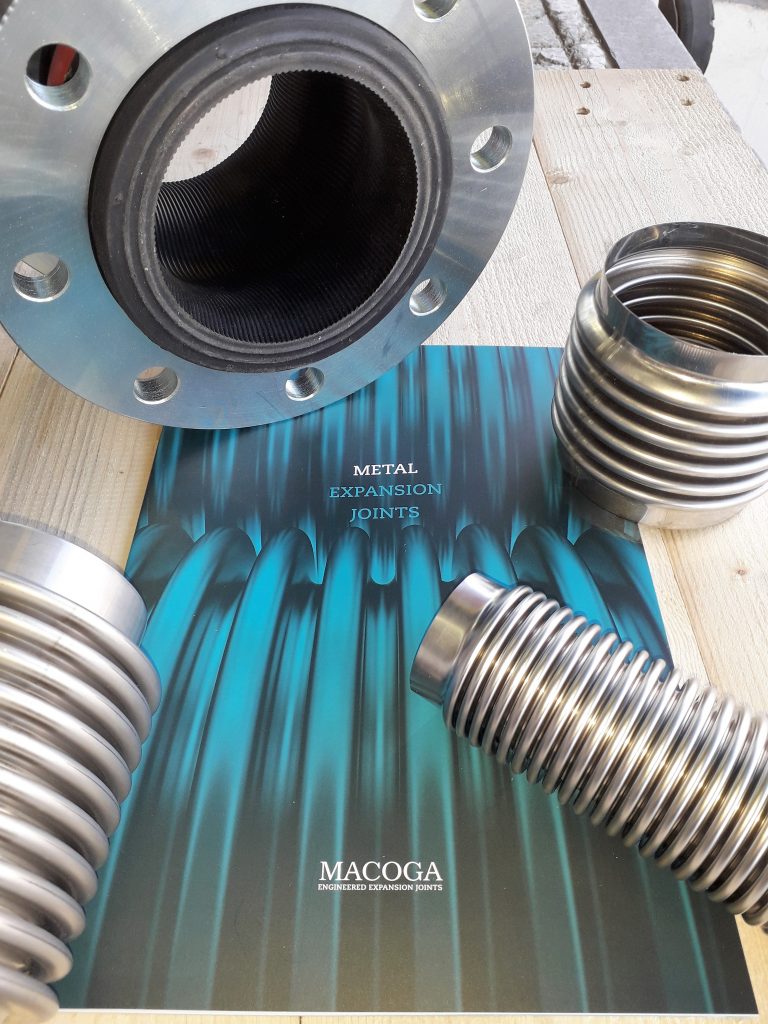
Macoga Metal Expansion Joints
Thermal growth, equipment movement, vibration, and pressure pulsation can create movement inside a piping system. If the system cannot absorb this movement, an expansion joint provides an effective solution.
An expansion joint uses flexible bellows to absorb movement while maintaining pressure and containing the medium flowing through the piping system.
The bellows act as the most important component of an expansion joint. This flexible element contains one or more corrugations along with end tangents, allowing the joint to handle different types of movement.
The most common connection methods include welding ends and flanges. Manufacturers connect metal expansion joints to pipes, machines, motors, and equipment through welding or flanged connections. In addition, some applications use screwed nipples or clamps.
Advantages of Expansion Joints
Expansion joints provide several important benefits, including:
- Require minimal installation space
- Absorb movement in multiple directions due to their flexibility
- Need little to no maintenance
- Reduce load and temperature loss
Types of Expansion Joint Movements
Expansion joints can absorb three main types of movement:
Axial Movement
Axial movement refers to the change in the bellows length from its free position. This movement occurs parallel to the longitudinal axis of the expansion joint.
Angular Movement
Angular movement occurs when the longitudinal axis of the bellows rotates around a specific point of rotation.
Lateral Movement
Lateral movement describes the sideways displacement between both ends of the bellows. This movement happens in a direction perpendicular to the longitudinal axis.
Expansion Joint Quality Control
Expansion joints require advanced engineering and precise manufacturing. Therefore, our Quality Control Department monitors every production stage carefully.
The process starts with raw material selection and continues through manufacturing, inspections, and final testing of each expansion joint.
Furthermore, all quality checks follow our Quality Control Manual, which meets ISO 9001 approval standards. We also follow strict quality procedures to ensure reliable performance. Lloyds approval is available for metal expansion joints, while class approval is available on request for rubber joints.

Contact Us for Expansion Joint Solutions
Whatever your application or expansion joint requirement, our experienced team can provide a suitable solution. We offer quick quotations and delivery timelines based on your project needs.
Contact us today for more information and pricing.